The Ontario Ministry of the Environment, Conservation and Parks (MECP) introduced key regulatory amendments on July 1, 2025 that affect how construction dewatering activities are permitted across the province. These changes – summarized in ERO Notice 019-6853 – are intended to streamline processes, reduce administrative burden, and provide greater clarity for proponents undertaking dewatering-related projects.
At VEI, we have heard from consultants, contractors, and municipal partners that, despite the intent of the amendments, there remains uncertainty about how they apply in practice. To help address this, VEI reached out directly to MECP representatives to seek clarification on interpretation and implementation. Their responsiveness and willingness to engage have been invaluable in improving understanding across the industry.
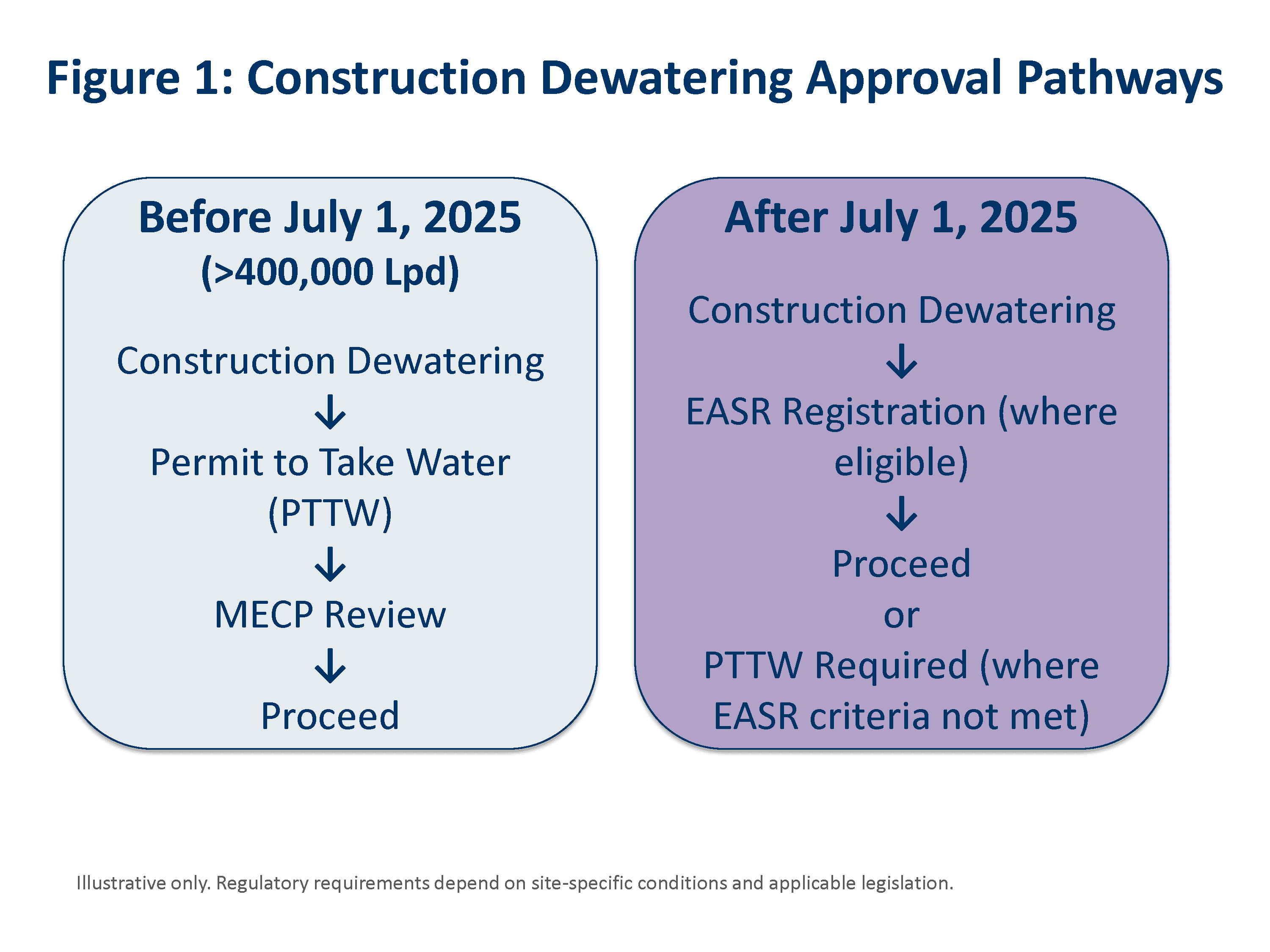
Ontario amended O. Reg. 63/16 (Environmental Activity and Sector Registry – EASR) to allow proponents to self-register additional construction dewatering activities on the EASR.
This represents a meaningful shift:
- More construction dewatering activities can proceed under EASR rather than requiring a formal Ministry review.
- In many cases, proponents may no longer need to apply for a Permit to Take Water (PTTW), provided the activity clearly meets EASR eligibility criteria, which previously added significant time to project schedules.
- The amendments aim to improve predictability and efficiency while maintaining environmental protection.
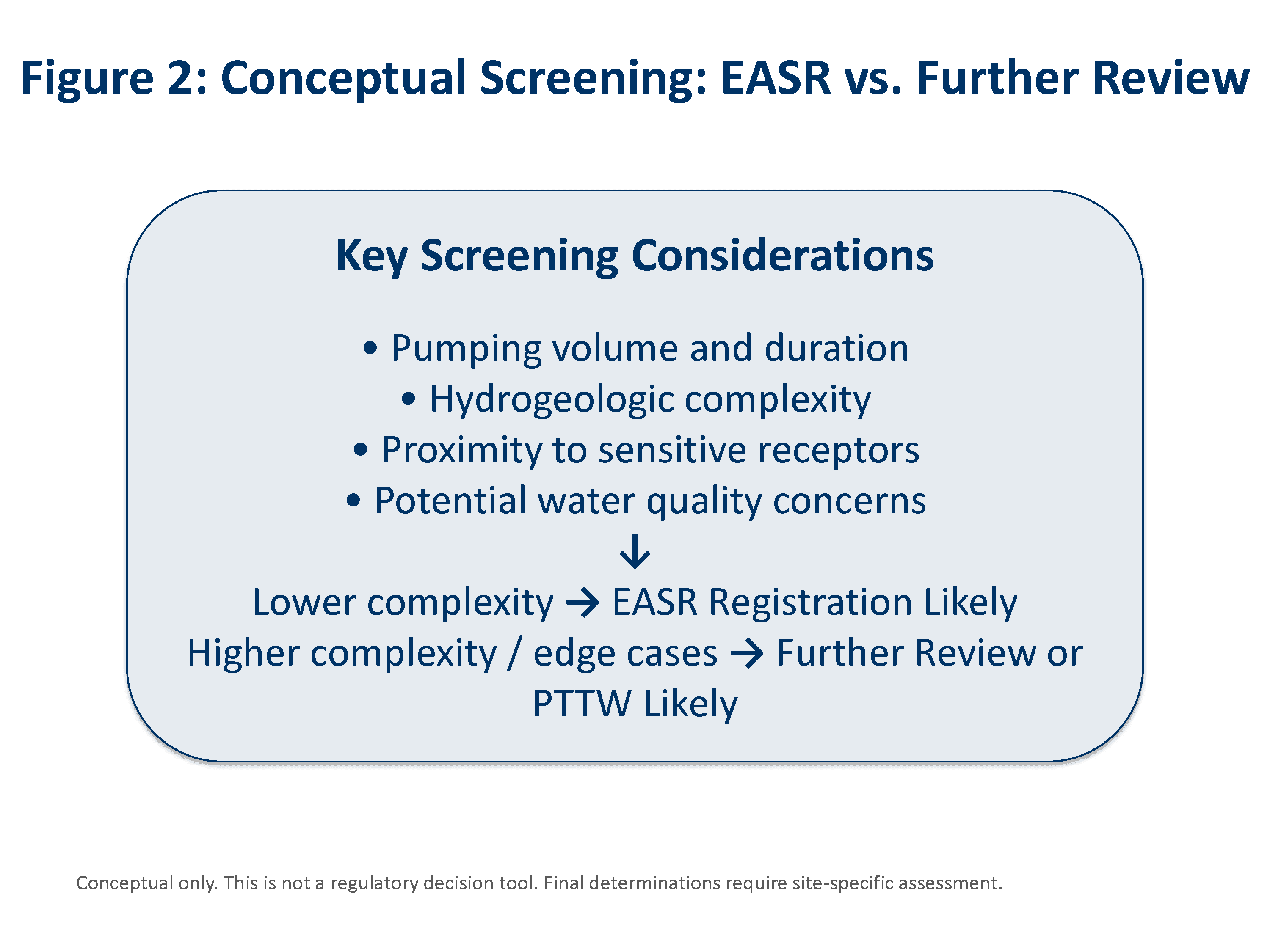
Figure 2: Conceptual screening considerations commonly used to assess whether construction dewatering activities may be eligible for EASR registration or may require further regulatory review, including a Permit to Take Water (PTTW).
Feedback from across the consulting and contracting community has highlighted several recurring questions:
- When is EASR registration sufficient?
- When is a PTTW still required?
- How do site-specific conditions affect regulatory obligations?
- What documentation must be retained to demonstrate compliance?
VEI’s objective in preparing this article is to help bridge the gap between regulatory intent and day-to-day project decision-making.
Collaboration with MECP
Throughout October and November, VEI engaged directly with MECP staff to confirm interpretations of the amendments and identify areas where additional clarity would be beneficial. MECP has emphasized its commitment to supporting proponents and qualified professionals as they adapt to the updated framework, and has indicated that additional guidance materials are in development.
- Streamlined approvals: More activities may proceed without lengthy PTTW review timelines where EASR eligibility criteria are met.
- Expanded role for Qualified Professionals: QPs are expected to apply professional judgment within the bounds of the regulation when determining appropriate regulatory pathways, discharge locations, and treatment requirements.
- Record-keeping remains essential: EASR registration does not remove the obligation to document compliance.
- Grey areas persist: High-volume pumping, complex hydrogeology, proximity to sensitive receptors, or potential contamination may still warrant MECP consultation.
- Further clarification is forthcoming: VEI will share additional ministry guidance as it becomes available.
Looking Ahead
While these amendments bring welcome clarity to construction dewatering approvals, they also sit within a broader conversation emerging across Ontario around groundwater availability, infrastructure capacity, and how construction activities interact with long-term water resource management. In the accompanying newsletter article, we explore how international practices and local water-supply constraints are prompting new ways of thinking about groundwater during growth.